Start with the hardware you already run
BeeGrow AI operates above sensors and control equipment. The exact path depends on the make, model and protocol, so every integration is validated before it is promised.
Getting your readings into the platform
MQTT
The primary ingestion path for supported sensors and controllers. Message formats and topic structure are validated and mapped to your site and zone model during onboarding.
Modbus
Configured Modbus TCP polling is available for supported sensor hardware. RTU and vendor-specific climate-computer integrations require a compatible site gateway or adapter.

REST and webhooks
The platform has a gateway API and webhook delivery. External endpoint and event coverage is documented per licensed integration.
What we will not claim. Modbus RTU, BACnet, OPC-UA and proprietary controller buses are not blanket-supported. They need a site gateway or a purpose-built adapter, and we will tell you which before you sign rather than after. The evaluation guide sets out the protocol questions worth putting to every vendor.
Actuators are configuration, not code
A platform that needs an engineering release to support a different dosing pump is not hardware-agnostic. Each actuator is described as a record with its own type, command set, control direction, MQTT topic and hard operating limits, so adding equipment is a configuration task with a test action attached.
HVAC
Heating and cooling
Humidity
Humidification and dehumidification
pH dosing
Separate up and down pumps

EC dosing
Two-part nutrient dosing

Water
Pumps and drain valves
Atmosphere
CO₂ injection

Ventilation
Extraction and circulation fans
Lighting
Intensity and spectrum channels
Reading types in the product model
BeeGrow AI models these readings consistently across the operational record. Sensor inputs, validation and calibration workflows are matched during onboarding.
Air temperature
°C, per zone and per sensor position
Relative humidity
%RH, with derived VPD and dew point
CO₂
ppm, per zone, against the recipe target
Light
PPFD in µmol/m²/s and lux, with daily light integral
EC
mS/cm in the feed and the root zone

pH
Feed and root-zone pH with calibration history
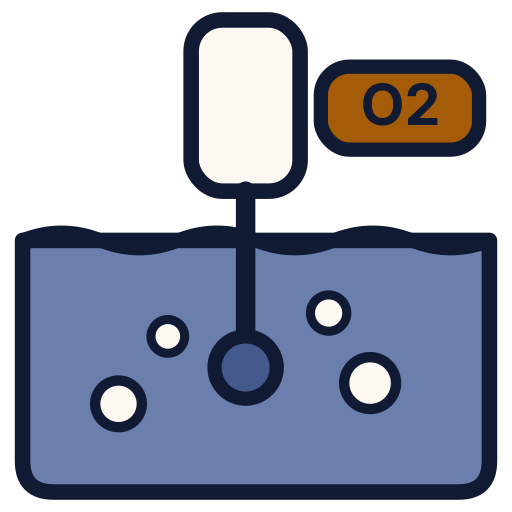
Dissolved oxygen
mg/L for recirculating systems
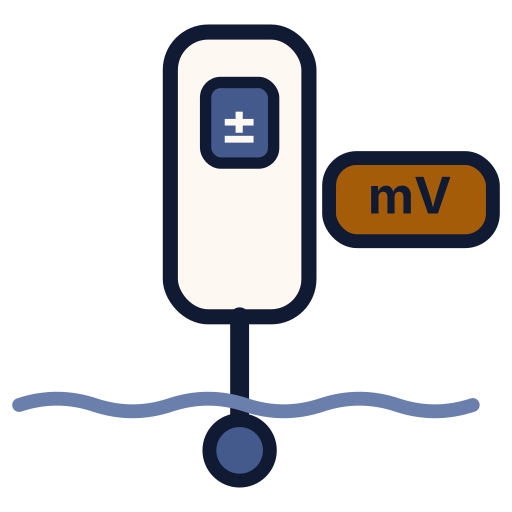
ORP
mV for disinfection monitoring
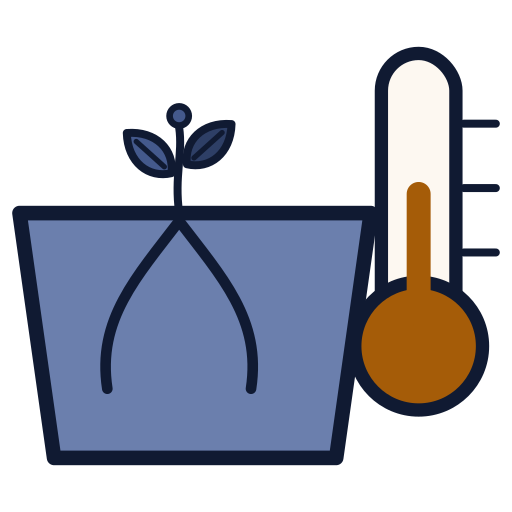
Root-zone temperature
°C, tracked separately from air
Water level
cm in tanks and channels, checked against the safety limits
Electricity
Half-hourly consumption for the supply point, from a linked supplier account
Water
Volume in, volume returned, volume lost
Open data is a product commitment
Lock-in through data hostage-taking is a bad business model and a worse relationship. Your records stay readable through the same authenticated APIs the platform uses, with external access licensed per integration, and at the end of a contract we produce a full copy for you. There is no scheduled export, and no one-click export of a whole account, today.
- REST API. Authenticated gateway APIs serve the web and mobile clients and approved external integrations.
- Webhooks. Subscriptions deliver supported operational events to connected systems.
- Onward analysis. A reporting or BI tool with licensed API access reads the same authenticated APIs the platform uses, so it sees the live record rather than a stale extract.
- Exit export. A full copy of your data, produced by us on request. Your agreement states the format, timing and retention window.
Typical onboarding sequence
Site and zone model
We map your sites, zones, equipment and crops.
Sensor mapping
Topics and registers bound to zones, units verified against a known reading.
Recipes and users
Your existing crop plans become versioned recipes, staff get roles.
Run a cycle
Read-only first if you prefer, with control added once the data is trusted.
Integration questions
My sensors do not speak MQTT. Can you still read them?
Possibly. MQTT is the primary path and configured Modbus TCP polling exists for supported sensors. Other serial, REST or proprietary sources need a gateway or a new adapter. Tell us the make and model and we will confirm what works today before proposing anything.
Can BeeGrow AI control equipment, or only read from it?
MQTT-based actuator control is available. Vendor-specific climate-computer connections are scoped integrations rather than blanket compatibility claims. Any two-way control is validated per controller with explicit safety limits and commissioned read-only first.
What happens if the network drops?
It depends which link drops. A phone that loses signal may still show previously loaded data, but recording something new needs the connection back: there is no offline write queue today. If site readings stop arriving, BeeGrow cannot continue normal feedback control. Equipment behaviour depends on the installed controller, its last command and its local safeguards; automatic handover to a climate computer is not guaranteed. Gateway buffering and the response to connection loss are confirmed and tested for your installation during commissioning.
Is there an API?
The web and mobile clients use authenticated REST APIs through one gateway. External API access, key management and webhook event coverage are licensed and documented for the integration endpoints in your solution scope. Ask us to demonstrate the endpoints and permissions your integration needs.
Can BeeGrow AI drive actuators, and what stops it doing something dangerous?
Actuators are described as configuration rather than code: each has a type, a command set, a control direction and an MQTT topic, plus hard ceilings on intensity, duration and minimum interval. Beneath that, on the automated control path, sits a fixed platform safety envelope on temperature, pH, EC, water level and dose frequency that no recipe, schedule or model output can raise. See closed-loop control and safety.
Do you connect to anything outside the farm?
Yes. The Octopus integration uses supported tariff data to compare the cost of lighting schedules. Account-linked features require the relevant supplier access. See energy and tariff optimisation.
Tell us what hardware you run
Send us your sensor and controller list. We will come back with an honest assessment of what connects easily, what needs a gateway and what is not worth the effort.
- Walkthrough led by someone who has built the system
- We map your zones, crops and sensors before the call
- Straight answers on what fits and what does not